StrategIQ. Unconventional leadership. Exceptional results.

Case study  /  Direct Pediatrics

Built to get a parent to the meet-and-greet.

Direct Pediatrics is a membership pediatric practice in Louisville, with offices in Norton Commons and Middletown. A monthly fee replaces insurance billing, so families get same-day visits and their doctor's own number. I rebuilt the site to remove every point of friction between a parent and one next step: scheduling a meet-and-greet.

Client
Direct Pediatrics
Role
Strategy, design, and build
Launched
October 16, 2026
Live site
directpediatrics.com
1
tap to the meet-and-greet, on a computer or a phone

100
PageSpeed in all four categories on the live site
33
answers to families' questions, up from 13
3
HIPAA-compliant forms, enrollment included
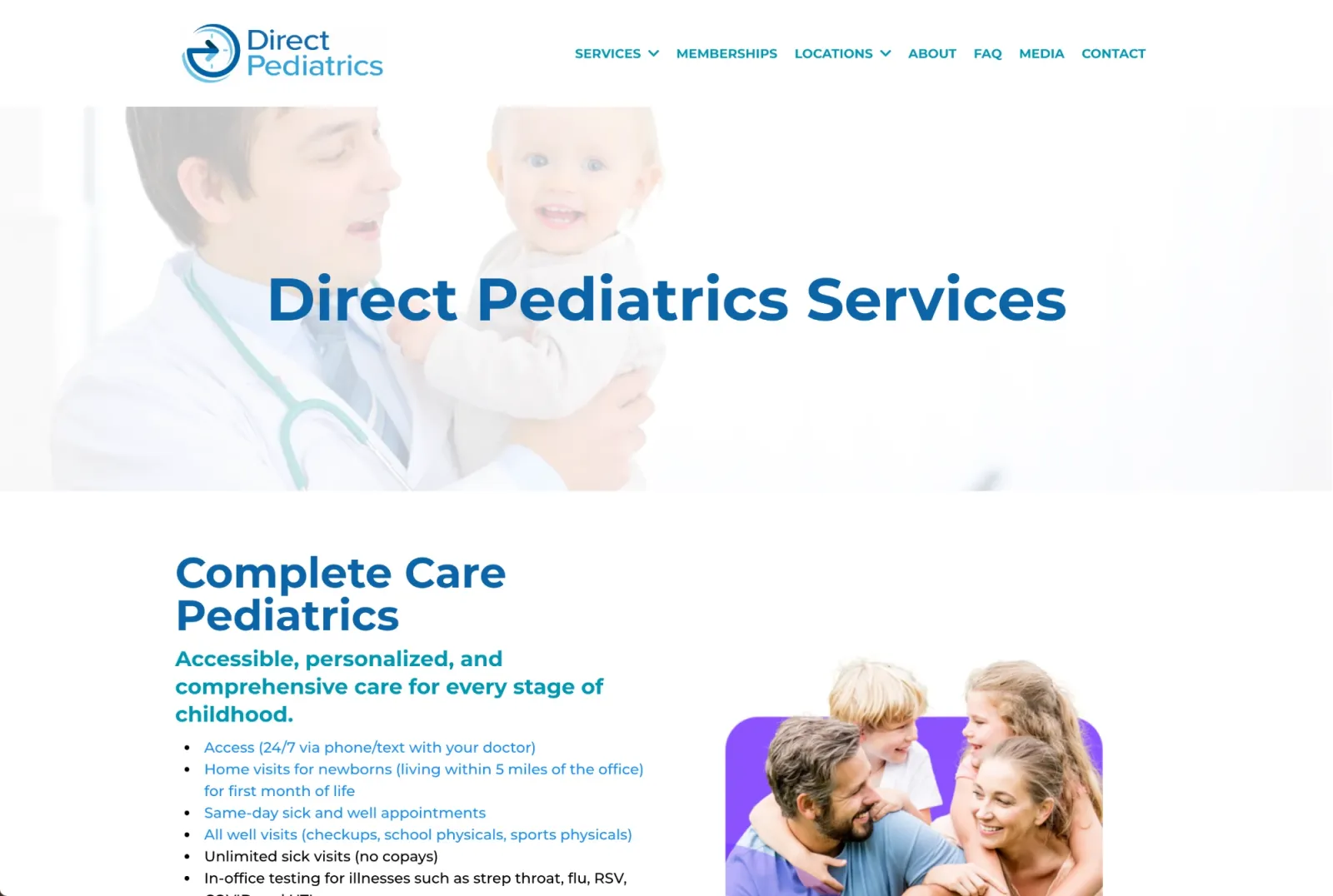
The old Direct Pediatrics services page: a faded stock photo behind the title “Direct Pediatrics Services” and a bulleted list of what membership includes.
BeforeThe previous services page.
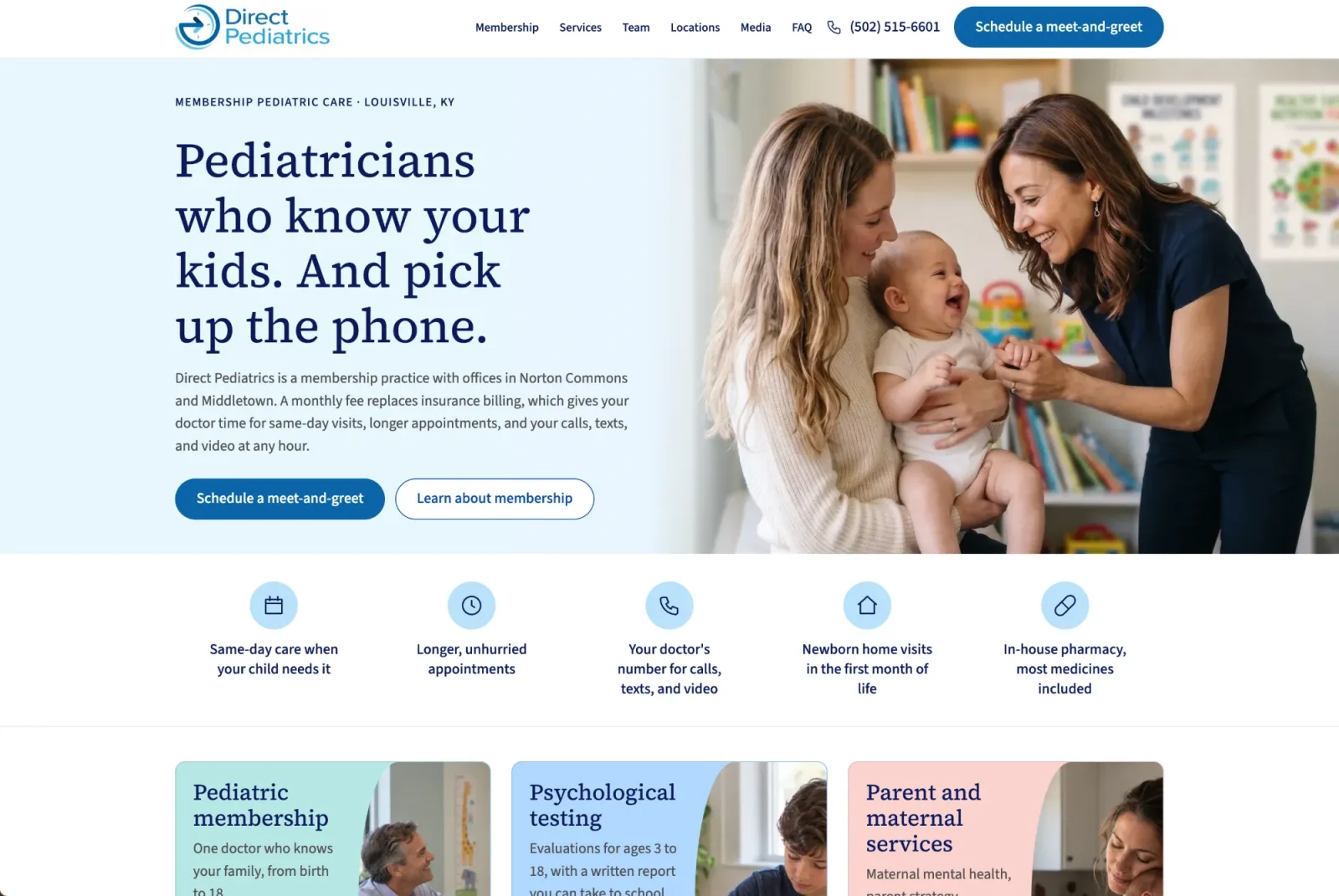
The new Direct Pediatrics home page: the headline “Pediatricians who know your kids. And pick up the phone.”, a photo of a pediatrician with a mother and baby, a button to schedule a meet-and-greet, a row of membership benefits, and cards for membership, psychological testing, and parent and maternal services.
AfterThe new home page leads with what membership gives a family and puts the meet-and-greet first.

01  /  The starting point

A care model many families haven't seen before.

Membership pediatrics is still new to many parents, and they need it explained before they take the next step. Direct Pediatrics also offers psychological testing and services for parents and new mothers, from two offices. The site had to answer a parent's first questions plainly, carry forward everything the practice had already published, and get the practice found for more than its own name.

The old site gave search engines almost nothing to work with. Its home page was titled “Home,” and the two files a search engine reads first, robots.txt and the sitemap, were empty. Before launch, the practice showed up in Google for its own name but not for “pediatrician Louisville” or for psychological testing, maternal mental health, or parent coaching. And the site, its forms, and the practice's contact data all lived in a vendor's account.

02  /  The approach

Every page leads to one step.

A parent choosing a pediatrician wants to know what membership is, what it costs, and who the doctors are. The site answers those questions plainly and then gets out of the way.

  • A meet-and-greet button always within reach: in the header on a computer, and in a bar at the bottom of the screen on a phone. The call button in the header reaches the office in one tap.
  • Pricing on the membership page, so a parent knows the cost before reaching out.
  • A short request: who the parent is, the child's age, the office and doctor they prefer, and the days and times that work. It goes straight to the front desk, which confirms the visit.
  • Built for the phone first and quick to load, so a parent isn't kept waiting.

Families who come for psychological testing or parent and maternal services have their own path to the right scheduler or consultation.

03  /  What shipped

The site, the forms, and the practice's library.

  • 25 pages, with one for each service, each office, and each provider.
  • Meet-and-greet, contact, and enrollment forms on a HIPAA-compliant form service the practice holds in its own name, under its own BAA.
  • The practice's media library carried forward: its videos, newsletters, podcast, and the doctors' books, now hosted on the practice's own site.
  • 33 answers to the questions families ask most, up from 13.
  • Every old address redirected, on the bare domain and on www, and crawled clean against the live site on launch morning.

04  /  Search and AI

Built to be found for more than its own name.

Parents look for a pediatrician by place and by need, and more of them now ask an AI tool instead of scrolling a list of links. The new site was built for both.

  • Structured data on every page describes the practice, each office, each provider, and the membership itself, so search engines and AI answer engines can tell who the practice is, where it is, and what it costs.
  • Every answer is marked up as a question and answer on the one page that owns it, so search engines and AI tools can quote the practice's own words.
  • The practice's name, addresses, and phone numbers are tested to match across every page, the structured data, and the files written for AI tools.
  • AI assistants get the whole site in plain text through llms.txt and a full-text companion, and the AI search crawlers are allowed in by name.
  • A sitemap dated by each page's last change, and IndexNow, so search engines learn about an update the day it ships. Bing accepted every page on launch morning.
  • PageSpeed scores of 100 in all four categories on ten pages of the live site, on a phone and on a computer. The home page had scored 55 before the YouTube player was replaced with a click-to-play thumbnail, so no third-party code loads until a parent asks for it.
  • A search baseline, taken before launch across 12 searches parents make, so every change can be measured against where the practice started.

05  /  How it ran

On time. Thirty days, signature to go-live.

  • Sept 5Proposed scope and a 90-day plan sent to the founder.
  • Sept 10Planning session that set a focused first phase.
  • Sept 16Agreement signed.
  • Sept 18First build day: the foundation, the home page, the interior pages, structured data, and redirects.
  • Oct 4In-person review with the founder.
  • Oct 12Walkthrough with the founder, who set the launch for Friday.
  • Oct 13Every change from the walkthrough on the preview by the next morning, and the site sent to the staff for an accuracy review.
  • Oct 15Launch eve. Every generated picture approved by the provider it shows, and the DNS zone built in the practice's own account.
  • Oct 16Live at 7:08 in the morning, on the date the agreement set.

Every email and text got an answer within a day, usually the same day. Changes the practice asked for were on the preview in hours, not weeks, and I flagged each problem with a proposed fix before they had to ask. Each decision was made in a working session, confirmed in writing, and recorded with the name of the person who made it.

395
dated decisions on record
840
automated checks before every change ships
549
items from the old site tracked to the new one
0
minutes of email interruption in the DNS move

06  /  Behind the site

The part a visitor never sees.

The site was built the way software is built, so it can change without a rebuild and run without me.

  • Written before it was built. The scope and constraints, the platform choices, the design brief and theme, the approved home page concept, and a wireframe for every other page existed before the first line of code.
  • 395 dated decisions on record, each with its reasoning, and with a name and a date whenever the decision was the practice's. When someone asks why the site says what it says, the answer is a row in a file, not a memory.
  • 840 automated checks before every change ships. They fail on the things a website build rarely checks: a phone number that differs between the page and the data Google reads, a price in the structured data that a parent can't see on the page, a claim nobody confirmed, an em dash in the copy.
  • Nothing the practice had built was left behind. Every one of the 549 items on the old site, from services and facts to videos, newsletters, documents, and form fields, has a row in an inventory that names where it lives now, and the build fails if one ever disappears. Anything dropped was dropped by a named decision with a date.
  • A launch gate. The site could not go live while any picture made from a provider's likeness lacked that provider's dated approval, any neighborhood name on an office page was unconfirmed, or any inventory row was open without a ruling.
  • The DNS move, checked record by record. All 17 records were mirrored into the practice's own Cloudflare account and compared live against both sets of nameservers before the switch. Email never blinked.
  • Everything in the practice's name. Hosting, DNS, and forms sit in accounts Direct Pediatrics owns, with nothing under a vendor's login.
  • Handed over with a runbook, written so someone other than me can change a phone number, add a provider, add a newsletter, or roll back. A new service page is one content file and no new design.
“It was a pleasure working with Chris! He delivered on all the facets of a project which are very important to me: on time, above and beyond, communicative, and collaborative with my team. He strikes a great balance and value add by not only considering what we need from a technical standpoint but also with understanding our brand, marketing, customer and business development needs.”
Josh Honaker, MD, Founder  ·  Direct Pediatrics

07  /  What's next

Launch is the first phase.

The 90-day program I proposed after launch puts one message across everything a family sees: a message guide built with the doctors and current families, rebuilt Google Business Profiles for both offices, corrected listings for the practice and each doctor, a review flow, pages for referral partners and employers, and a one-page monthly report that tracks every new family to its source.

Stalled, unclear,
or on fire? Chaos has a case manager.

Send a message

Your message comes straight to me by email. This site doesn't store it.